
Introducing Tesseract GPT 2.0 — the one-goal prompt chain for stock price prediction.
Structured. Low effort. Unbiased.
10 sequential prompts
400+ pages of documentation that guide the research
Inspired by the latest literature by Stanford and Columbia studies
Easy export to LLM models beyond ChatGPT like Claude, Gemini, etc
2D reconstruction of the current chain layout, kept intentionally clean so you can later replace it with the final production infographic.
Stock research is noisy and in most cases “against” you
Yahoo Finance, Bloomberg, Motley Fools and other financial media outlets that thrive on sensation and not substance.
AI Saas screeners that spam you with 50 recommendations per day.
Discord servers or forums where anonymous people post their due diligence trying to convince others to join the rollercoaster.
Financial advisors with countless conflicts of interest that try to sell you the boring thing that will make them the most commission.
Finance gurus who live by selling courses and do not even trade…

The big problem with AI investing tools…
Nowadays they are plentiful, packaged in different formats, yet they all suffer from a similar disease. They give hundreds of recommendations and this way totally overwhelm the client and later they probably gaslight him by telling him that a certain percentage of these 100 picks perform well. Well, of course, a certain percentage would perform well.

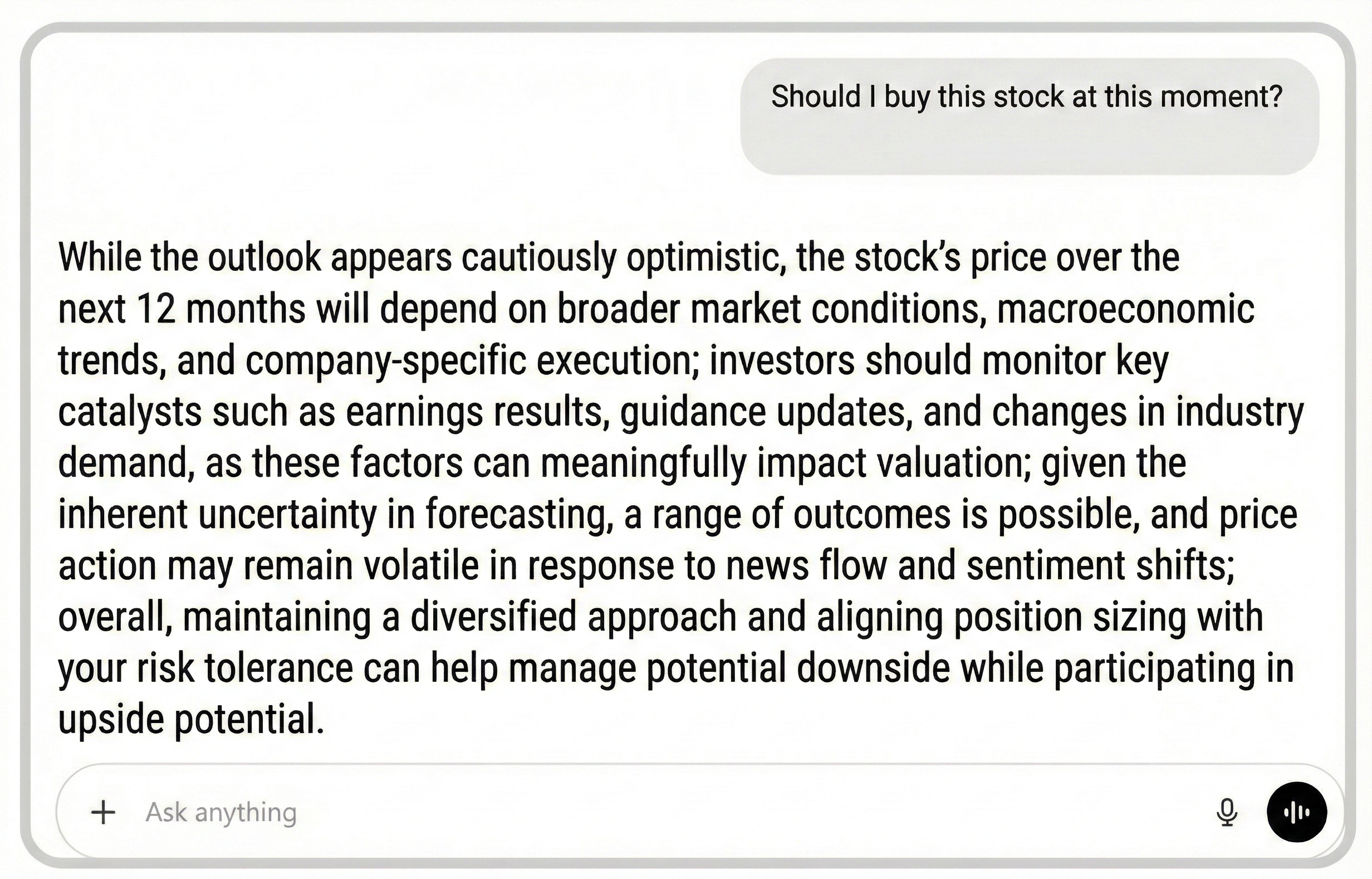
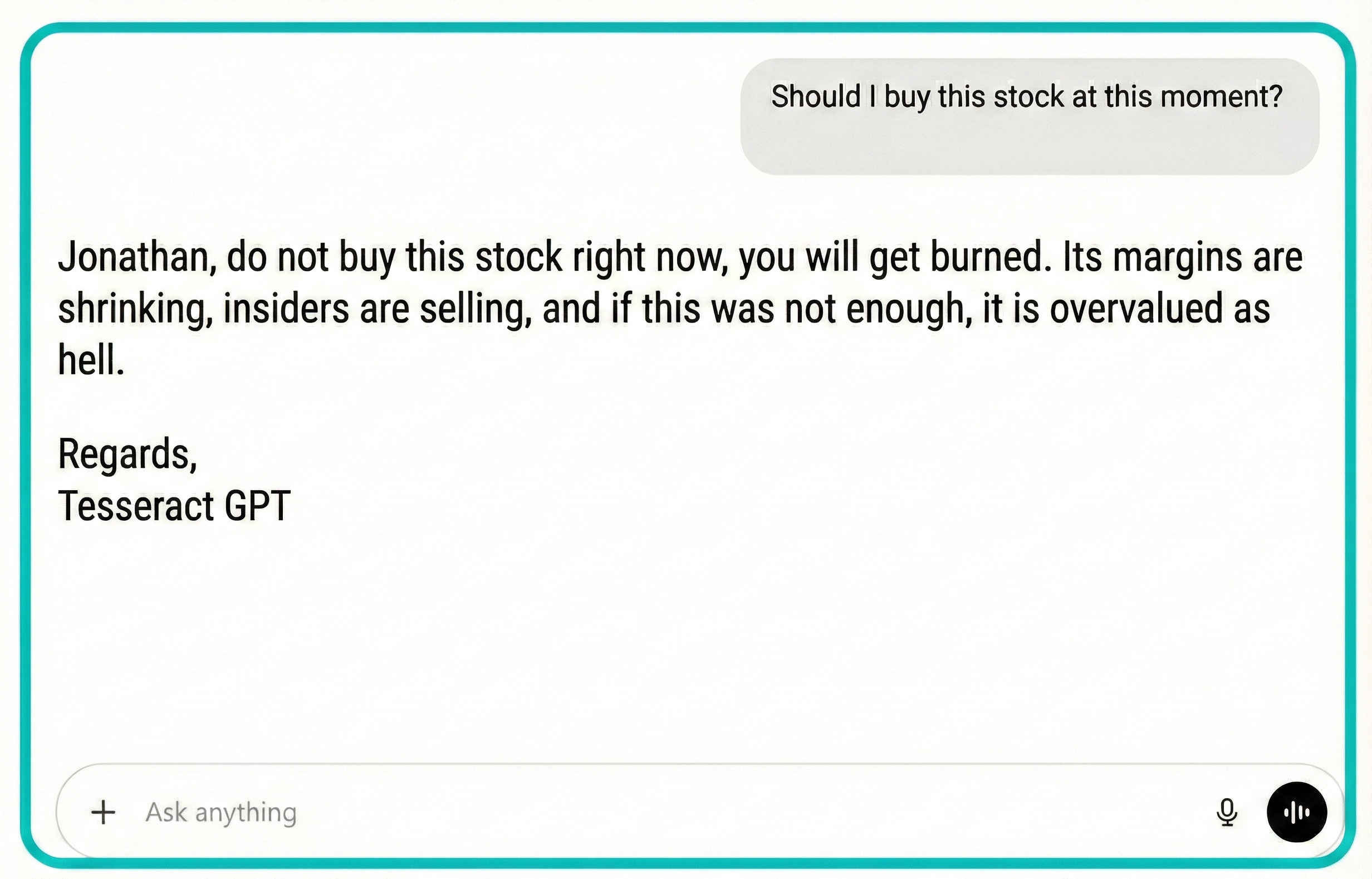
2 ways of AI assistance in stock analysis
The old way
The new way
Three output modes, depending on what you need
You only need to run the chain once to get all the three outputs in the end. If one page is not enough, you can simply say, give me the advanced/max version.
Standard
1 page
- Fastest way to judge an idea
- Clear thesis, risks, catalysts, target
- Best for most situations
Advanced
3 pages
- More context, numbers, and nuance
- Deeper view of thesis strength
- Best for heavier due diligence
Maximum
10 pages
- Maximum depth for complex cases
- Full breakdown of thesis mechanics
- Best after shorter modes
Statistics
90%
maximum time reduction for the analysis of a stock investment thesis
<2 min
the average time that the user will have to spend on his own for 1 final output
400+
pages of instructions, guidelines and best practices on the backend
20x
more information considered, compared with single prompts
What you get with Tesseract GPT 2.0
A complete research workflow built to save time, improve clarity, and make your output more decision-ready.
Pro-Chain workflow
A structured prompt-chain system designed to move from raw input toward cleaner analytical output.
Support library
Internal documents and research materials that strengthen the reasoning behind the generated work.
Tutorials included
Written and video guidance to help you understand the system and apply it without friction.
Maintenance protocol
A system for updating prompts and resources so the workflow can keep evolving over time.
Resource expansion guide
Extra guidance on how to make the framework stronger with added inputs, context, and source material.
Build your own workflow
Import the framework into your own process and adapt it into a more customized research engine.
The core premise
(prompt chains win)
Pro-Chain beats single prompts, Agent mode and Deep Research for deeply analytical tasks
Chains force structure (no wandering)
Chains stack context (each step improves the next)
Chains stress-test before committing (less confident nonsense)


The proof from Stanford & Columbia studies
Sharper decisions: multi-step workflows produced up to 5x stronger performance on difficult reasoning tasks.
Better reasoning: Stanford showed that structured search pushed success from 4% to 74% on a hard planning task.
Accuracy: a 2025 study showed 70.7 vs 42.5 for a structured action-chain workflow over chain-of-thought.
A commentary on the result of the studies can be found in this article from our blog.
I was the first client of this system.
Tesseract GPT was built for my own use before it was ever turned into a product. I needed a system that could force structure, reduce noise, and push a stock thesis toward a real decision instead of generic commentary. I use the same logic for myself as a trader and investor, which is exactly why the product is built the way it is: narrow, disciplined, and focused on one outcome only.
I do not sell a workflow I would not trust for my own process.
How you use it?
You write the name of the stock in the first prompt
You copy and paste the sequence of given prompts
You read the final analysis.
And that’s it! The 400+ page logic runs in the backend.
The system is built to save you time and mental power so you can be more confident before acting in the markets.
Want to see a video tutorial? Check this Youtube video.
Can it be used for other purposes?
Comparing stocks
Analyzing ETFs
Assisting in equity reports
Monitoring specific companies
Yes, it can do all of that and much more, as long as the underlying object of the analysis is equities.
Guided by proprietary resources...
The engine doesn’t rely on random web browsing. It draws from private, curated material that guides each step.
Read more about the logical ratio of choosing proprietary information as the best choice for highly complex tasks in this article of the blog:
Article titleNote: The customization of the system is not advised to people that don’t know really well what they’re doing. These people fall under 2 categories, experienced investors or highly competent people working in equity analysis.
...while being fully customizable
A detailed guide is included in the system, describing every aspect of customization options and even giving tips.
This allows the user to apply his methodology, mindset and worldview to the system, without starting from scratch.
Read more about why customization freedom gives the user so many opportunities to shape the workflow based on his specific needs in this article of the blog:
Article titleTechniques and concepts used for the system logic
Mathematical concepts
Deep analytical logical concepts
Historical data
As a fan of computational statistics I have included the thoughts behind the mathematical logic of the system in this blog article:
Article titleThe intention of the system is one and only
“The end result will be one of the best pieces of information that an equity investor can use to decide about a specific investment decision.”
Why a public LLM can’t do this
A public model can be useful. This system is useful in a narrower, more disciplined way. The difference is not just intelligence. It is workflow, constraints, and what the analysis is built to produce.
Built to handle many different tasks.
Built for one specific equity-analysis workflow.
Starts from a blank conversational state.
Runs through a predefined structured chain.
Can wander depending on prompt quality.
Forces ordered steps before reaching conclusions.
Gets guidelines on the go for each new question.
Includes guidelines and best practices inside the internal material.
Can vary a lot from run to run.
Designed for a specific output format.
Can be strong, but usually needs excellent prompting.
Depth is baked into the workflow itself.
Can sound confident too early.
Meant to stress-test ideas before committing.
General flexibility, but not naturally tied to your framework.
Can be shaped around the user’s methodology and system logic.
A conversation or answer.
Condensed reports built for decision making.
But why not trust the target prices published by banks and equity research firms?
Because they are fundamentally biased.
Do you think that the best opportunities are published for free?
Do you think that $20 per month blog subscriptions are built to make you rich?
That’s the problem, the best research is hidden from the public or gatekeeped as hell.
Historically speaking, equity research analysts give vastly positive projections.
The reason is simple, companies pressure rating firms on one hand and there are hidden incentives for publishing biased projections, that oftentimes even the analyst himself doesn’t believe.
Note: There are many outstanding and hard working equity research analysts in the world, here the reference is made to the misaligned incentives and the way in which investment advice is given, not to the skills of the people.
How can it help a beginner or part-time investor?
It gives a beginner a more structured way to think before acting on a stock idea.
It reduces dependence on shallow one-shot answers by forcing a clearer analytical path.
Read more about how Tesseract GPT can help a beginner investor in this article of the blog.
Article linkAnd how can it help an experienced investor?
It speeds up repeatable research without removing the investor’s own judgment and framework.
It gives a disciplined base process that can still be shaped around personal methodology.
Read more about how Tesseract GPT can help an experienced investor in this article of the blog.
Article linkCan it actually help an analyst? Yes, but only in its advanced variant.
The advanced version is more suitable when deeper structure, customization, and support material are required.
It is better suited to analysts who want condensed research outputs rather than casual conversational answers.
Read more about how Tesseract GPT can help a professional analyst in this article of the blog.
Article linkHow does it save time?
3 practical scenarios
Kill bad ideas fast
Filter weak setups earlier, so you spend less time following ideas that were never worth serious attention.
Accelerate promising research
Move through a serious investment case with more speed, without collapsing the structure needed for good analysis.
Research more at scale
Screen a larger set of opportunities in a disciplined way, then narrow your focus to the strongest candidates.
What happens after you buy?
People need to know:
how access is delivered
whether it is instant
what files they receive
whether they need another tool
whether setup is hard
This is a major conversion point for digital products.

Who it is not for
not for SPY, QQQ, VIX traders
not for equity day-traders, there will be a specific product for them
not for people wanting instant trade alerts
not for people who won’t read a one-page memo












Choose the plan that fits your workflow.
Simple tiers for different levels of depth, access, and support. Start free, scale up when you need more.
Free
Best for exploring the workflow
A simple entry point with a light version of the system and a small sample of the overall experience.
- Basic access to the workflow
- Short-form output example
- Light resource pack
- General access tier
- Email delivery included
Basic
Best for focused individual use
A direct version with more depth, more usable outputs, and a cleaner path from input to decision-ready result.
- Full access to one core workflow
- Expanded output depth
- Practical notes included
- Resource sheet included
- Fast digital delivery
Advanced
Best for serious users who want more depth
A more complete package with deeper materials, stronger supporting resources, and a better overall working kit.
- Everything in Basic
- Deeper workflow coverage
- Extra supporting files
- Expanded reference material
- Higher-value guidance
- Priority delivery tier
Professional
Best for teams or heavier usage
A bundled option for users who want broader coverage and more value across several product categories at once.
- Three products in one bundle
- Stronger total value per dollar
- Wider category coverage
- Better fit for power users
- Simplified purchasing path
Custom Solutions
Need something tailored to your exact workflow?
For custom research workflows, special packaging, or a more tailored setup, get in touch and we’ll discuss the right structure together.
An example of output difference
Generalistic LLM

Tesseract GPT 2.0
The system was shaped by a real problem, and three months of research and optimization
It all started with one client, an investor who had underperformed the S&P 500 for the last 10 years, except 2023.
After he got tired from me telling him that I would not consider his preferred tech stock as a good investment he eventually found solace at ChatGPT and started using it as an alternative.
I just told him “Ok, please just share some screenshots of the conversation with me, will review them for free”.
He did and what I saw was a mediocre inconclusive slop that eventually guided him towards a “buy”.
Fair enough, but then I checked the sources, it was a mix of Yahoo Finance, Reddit, Wikipedia, and Jim Cramer’s opinions as a cherry on top.
That was the moment I realized that I had to do something…

The mindset and logic behind this system
AI tools…
The system is built to save you time and mental power so you can be more confident before acting in the markets.
The real work happens in the backend…
Maximum power for one purpose.
This whole system is built with only one intention: to give the investor the absolute maximum level of research that an LLM can give at this moment in time in history.
It’s hard to believe that there is a more accurate, deeper way to do this specific task without enterprise capabilities or exclusive data.
Got questions? Do not hesitate to ask. Usually answering in less than 24 hours.
Frequently Asked Questions
-
We offer a range of solutions designed to meet your needs—whether you're just getting started or scaling something bigger. Everything is tailored to help you move forward with clarity and confidence.
-
Getting started is simple. Reach out through our contact form or schedule a call—we’ll walk you through the next steps and answer any questions along the way.
-
We combine a thoughtful, human-centered approach with clear communication and reliable results. It’s not just what we do—it’s how we do it that sets us apart.
-
You can reach us anytime via our contact page or email. We aim to respond quickly—usually within one business day.
-
We offer flexible pricing based on project type and complexity. After an initial conversation, we’ll provide a transparent quote with no hidden costs.
-
Collaborative, honest, and straightforward. We're here to guide the process, bring ideas to the table, and keep things moving.